"Content is King!"
So says everyone. Except the majority of business decision-makers, who tend to fasten on hardware and software and price. They can't help it; they just gotta know "how much will this cost me?"
For any DOOH or other digital signage display, the content is critical. With all the advances over the past 5 years or so, the issue of high-quality content is still a tough one, because, face it, true creative costs something.
Example: I just spoke with a major international brand that is installing a very large, multi-tile video wall in their corporate Headquarters lobby, where everyone will see it. Great idea!
But they decided, for content, they will go with their in-house app-designer because they don't have a budget for content. Now, keep in mind, this company manufactures key components for digital displays. They are a major player.
Ya gotta be kidding me!!! You have budget to install a very large multi-tile video wall, but you forgot to allocate ANY budget toward content???!!!
So much for "Content is King." Truth is, for so many otherwise smart business decision-makers, content is an ugly step-child, neglected and unwanted. Shoot, the content should just come with this great hardware, right?
So the King, the prince, is actually a pauper. No one will give him a dime.
When was the last time you saw a truly engaging, stop-you-in-your tracks digital display? Uhh, let me see.... you don't really see them very often, and the reason is, decision-makers focus on hardware and widgets. Something they can negotiate hard. Something they can commoditize. But the all-important content, the message, the thing that actually makes people move, THAT is too expensive, don't have a budget for it, we'll do it in-house.
This is a major reason why this industry doesn't rocket forward. The value (content) is a tough sell.
People, please: Set budget for this critical component of your display implementation. If you're a systems seller, or a software seller, or an integrator, get the client to put some cold hard cash value towards their implementation's content! It will make you look good, and they'll stand a better chance of getting the true value out of their purchase that they intended. And you'll sell more.
Friday, August 30, 2013


Wednesday, August 21, 2013
Projected Digital Signage
Why not put a screen in your window?
Because everyone has that. Well, not everyone, but even a big screen is just a big screen.
Window Video Systems (projected digital signage) allow for eye-popping effects, different size possibilities, customized visual formats, and most of all, a completely different effect than an installed screen.
Window Video Systems (WVS) use projection and rear projection films applied to window glass to literally turn the glass into a video screen---hence the name, Looknglas.
Businesses, especially retail, need and crave fresh, attention-grabbing content. The key to effective implementation is not hardware! (Everybody's so fixated on hardware and gadgetry---thanks Apple!)
The issue is, what do you have to say? What is the value of that message?
Invest in the message, a really good, powerful message, that is strategic and measurable. All the things I have been saying for years. Don't invest in hardware, invest in messaging to your target audience effectively, and you'll never go wrong.
Feel free to ask any questions about this system or how it can work for your business. Let's blow some minds!
Because everyone has that. Well, not everyone, but even a big screen is just a big screen.
Window Video Systems (projected digital signage) allow for eye-popping effects, different size possibilities, customized visual formats, and most of all, a completely different effect than an installed screen.
Window Video Systems (WVS) use projection and rear projection films applied to window glass to literally turn the glass into a video screen---hence the name, Looknglas.
Businesses, especially retail, need and crave fresh, attention-grabbing content. The key to effective implementation is not hardware! (Everybody's so fixated on hardware and gadgetry---thanks Apple!)
The issue is, what do you have to say? What is the value of that message?
Invest in the message, a really good, powerful message, that is strategic and measurable. All the things I have been saying for years. Don't invest in hardware, invest in messaging to your target audience effectively, and you'll never go wrong.
Feel free to ask any questions about this system or how it can work for your business. Let's blow some minds!
Thursday, June 6, 2013
Content is KIng - so Bow Down!
It has been oft repeated that "content is king!"
So, if that's the case, why do people consistently try to get their content for free or on the cheap?
So many in Digital Signage and DOOH are systems focused, and so very, very few focused on content production, production values, message, and message strategy.
I think it's often assumed this is the responsibility of advertising agencies, and marketing "people", but if you are installing or running a network, it needs to be your focus.
The message (content) is where the value is. You can have the best hardware and software platform, the best integration, the best technical support, but if the messages suck, the whole thing sucks.
Think of a Limo without seats, steering wheel or brakes.
Content (message) truly is king, and strategy must be queen, and the DS system, can only ever be the coach and four.
So, qualified, strategic content producers are a critical part of your success equation. That is, people who know more than just how to make a pretty picture. People who can create great visual messaging designed to accomplish real business objectives.
We like Phase 3 Digital, because they're both artistic as well as digital and strategy savvy.
Serious investment must be made in that expertise, that marketing message expertise and the appropriate production values that should accompany it. If the message and strategy are great, but the visuals look like hell, the campaign will fail, and then Digital Signage and DOOH takes yet another black eye. Don't do that to yourself, to your client, and to the industry; make sure that content and strategy are the best you can get. Get the best expertise and production at the best price you can, but don't sacrifice mission-critical standards to a bean-counter's mentality.
So, if that's the case, why do people consistently try to get their content for free or on the cheap?
So many in Digital Signage and DOOH are systems focused, and so very, very few focused on content production, production values, message, and message strategy.
I think it's often assumed this is the responsibility of advertising agencies, and marketing "people", but if you are installing or running a network, it needs to be your focus.
The message (content) is where the value is. You can have the best hardware and software platform, the best integration, the best technical support, but if the messages suck, the whole thing sucks.
Think of a Limo without seats, steering wheel or brakes.
Content (message) truly is king, and strategy must be queen, and the DS system, can only ever be the coach and four.
So, qualified, strategic content producers are a critical part of your success equation. That is, people who know more than just how to make a pretty picture. People who can create great visual messaging designed to accomplish real business objectives.
We like Phase 3 Digital, because they're both artistic as well as digital and strategy savvy.
Serious investment must be made in that expertise, that marketing message expertise and the appropriate production values that should accompany it. If the message and strategy are great, but the visuals look like hell, the campaign will fail, and then Digital Signage and DOOH takes yet another black eye. Don't do that to yourself, to your client, and to the industry; make sure that content and strategy are the best you can get. Get the best expertise and production at the best price you can, but don't sacrifice mission-critical standards to a bean-counter's mentality.
Thursday, May 9, 2013
Digital Signage and ROI
Phil Cohen cracks me up.
He does a video blog called "Cohen on Content" http://onthecspot.com/archives/1070 dishes on all things DS and DOOH. Being a successful owner of a network himself for years, he knows a thing or two about the subject.
So I was watching his latest post, and though he takes a while to get going, he makes some great points.
Point 1: Don't think you're going to create DS content with Powerpoint. You don't want him coming after you speaking a language he knows you'll understand. (He speaks fluent baseball bat.)
Points 2-10: It's not about impressions. It's not about eyeballs. It's about making money. You have to have engagement, and a way to prove that engagement, be it third party corroboration, sales, track-able promotions, or whatever, you need to show that you are accomplishing something, preferably making money.
DS and DOOH are not about putting up a screen where you think a bunch of people will see it. It is about effectively accomplishing serious business objectives. And you don't do that by being the next DIY digital signage failure. You do it by knowing what you're doing; what hardware and software platforms are apropos to your purpose, and what content and strategy will accomplish that purpose.
"It's about making money!" he says. And I say,
"Bravo, Phil!"
He does a video blog called "Cohen on Content" http://onthecspot.com/archives/1070 dishes on all things DS and DOOH. Being a successful owner of a network himself for years, he knows a thing or two about the subject.
So I was watching his latest post, and though he takes a while to get going, he makes some great points.
Point 1: Don't think you're going to create DS content with Powerpoint. You don't want him coming after you speaking a language he knows you'll understand. (He speaks fluent baseball bat.)
Points 2-10: It's not about impressions. It's not about eyeballs. It's about making money. You have to have engagement, and a way to prove that engagement, be it third party corroboration, sales, track-able promotions, or whatever, you need to show that you are accomplishing something, preferably making money.
DS and DOOH are not about putting up a screen where you think a bunch of people will see it. It is about effectively accomplishing serious business objectives. And you don't do that by being the next DIY digital signage failure. You do it by knowing what you're doing; what hardware and software platforms are apropos to your purpose, and what content and strategy will accomplish that purpose.
"It's about making money!" he says. And I say,
"Bravo, Phil!"
Friday, April 12, 2013
Engage, Interact, Then What?
Engagement is awesome. Interacting with your audience, intriguing them, interesting them, entertaining them, and... and... then what?
Many of us have gotten good at engaging through Social Media by creating or pushing relevant or interesting content. But once that's up and going, how good are you at moving beyond mere engagement to something more business related, like... wait for it... BUYING?!!! Here's a good example of engagement with audience:
This is a pretty technical display, and not cheap by any means. How much time would you see yourself spending interacting with this? Can you see yourself buying as a result?
Personally, I can't see this moving me any closer to a purchase.
Meaningful business-related engagement must be for the purpose of transacting at some point, preferably sooner than later. The average retailer couldn't dream of investing in this display long term or on a widespread basis. When the path to purchasing becomes clearer, then this type of display and technology becomes much more valuable to the retailer.
Don't get me wrong; I love this technology and attraction value, but I think it's a little disconnected from the rest of the customer experience in the clothes-buying process.
How would you revise this display to become a "customer-ing" engagement display tool? How could this be re-positioned to better encourage purchasing?
My philosophy is to use any display like this as a means to attract, engage, propose, incentivize, and motivate to purchase. But I'm kind of a fuddy-dud that way.
Your thoughts?
Many of us have gotten good at engaging through Social Media by creating or pushing relevant or interesting content. But once that's up and going, how good are you at moving beyond mere engagement to something more business related, like... wait for it... BUYING?!!! Here's a good example of engagement with audience:
This is a pretty technical display, and not cheap by any means. How much time would you see yourself spending interacting with this? Can you see yourself buying as a result?
Personally, I can't see this moving me any closer to a purchase.
Meaningful business-related engagement must be for the purpose of transacting at some point, preferably sooner than later. The average retailer couldn't dream of investing in this display long term or on a widespread basis. When the path to purchasing becomes clearer, then this type of display and technology becomes much more valuable to the retailer.
Don't get me wrong; I love this technology and attraction value, but I think it's a little disconnected from the rest of the customer experience in the clothes-buying process.
How would you revise this display to become a "customer-ing" engagement display tool? How could this be re-positioned to better encourage purchasing?
My philosophy is to use any display like this as a means to attract, engage, propose, incentivize, and motivate to purchase. But I'm kind of a fuddy-dud that way.
Your thoughts?
Friday, April 5, 2013
What's inside a Digital Mannequin?
I get a lot of requests for info about the Digital Mannequin, and Window Video Systems, generally.
Now, if you asked that question about a standard mannequin, it would be a very different kind of answer. Materials, structural joints, air, etc.
But a Digital Mannequin is a human representation. It is not a likeness, it is a digital leveraging of an actual person. This goes to the issue of content, concept, content creation, the interplay between tech and creative.
The question goes to the point of product (let's say, clothing) and strategically, the best way to sell that product. What model(s)? What makeup? What lighting? Background, resolution, luminosity, graphics, etc., etc. Who shoots that model? How much content do you shoot? Who selects the shots, angles, location, directs the models, on and on, you get the idea.
And what is the strategic concept for the display? Display only, or display and promo? What is the offer and how is it offered? What graphical style, font, size, color, other effects?
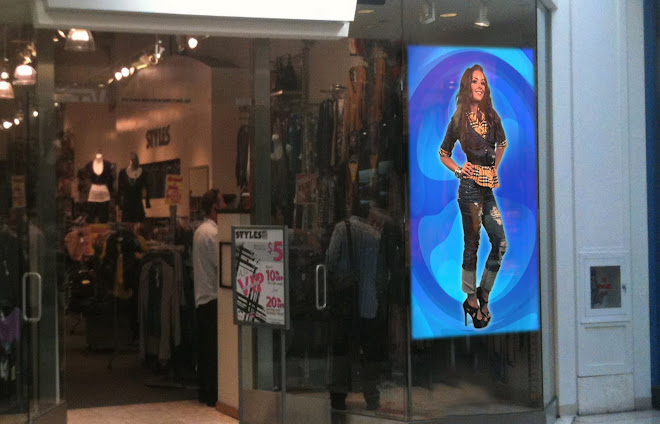
The photo at the top of this page shows an actual model, who was part of a shoot featuring 4 models, multiple costumes, wardrobe personnel, makeup artist, video camera man, director of photography, myself, and several others. This is not a DIY type of project!
When people say "content is king" these issues are part of what they mean. The hardware portion of a Digital Mannequin display is only a small part of the effectiveness of DM. The screen or projection is an important but only small part of the DM display. If you don't have the expertise in those areas, you need to find that expertise. Contact me for more info about how we can provide you the best integration, effect and result from your DM display.
Now, if you asked that question about a standard mannequin, it would be a very different kind of answer. Materials, structural joints, air, etc.
But a Digital Mannequin is a human representation. It is not a likeness, it is a digital leveraging of an actual person. This goes to the issue of content, concept, content creation, the interplay between tech and creative.
The question goes to the point of product (let's say, clothing) and strategically, the best way to sell that product. What model(s)? What makeup? What lighting? Background, resolution, luminosity, graphics, etc., etc. Who shoots that model? How much content do you shoot? Who selects the shots, angles, location, directs the models, on and on, you get the idea.
And what is the strategic concept for the display? Display only, or display and promo? What is the offer and how is it offered? What graphical style, font, size, color, other effects?
The photo at the top of this page shows an actual model, who was part of a shoot featuring 4 models, multiple costumes, wardrobe personnel, makeup artist, video camera man, director of photography, myself, and several others. This is not a DIY type of project!
When people say "content is king" these issues are part of what they mean. The hardware portion of a Digital Mannequin display is only a small part of the effectiveness of DM. The screen or projection is an important but only small part of the DM display. If you don't have the expertise in those areas, you need to find that expertise. Contact me for more info about how we can provide you the best integration, effect and result from your DM display.
Tuesday, March 12, 2013
Driving Retail
Digital Mannequin, screens in the window, digital signage a point of purchase, all should do more than display if you want return on your investment.
This video illustrates how the window display attracts attention, while larger in-store screens demonstrate specific sales promos. This method creates the excitement of dynamic motion-display, attracting customers' eyes and attention, motivating them to initial action (coming in the store,) then to buying action (promotional offer at point of purchase.) At this point, a "customering" offer can be made, text or QR coupon redeemable with the next purchase, or other reward-based promotion.
The important thing is to always include a trackable, measurable call to action. This is where creating that engaging, dynamic customer experience is possible, where the opportunity to create and strengthen a bond in one single line of messaging and action.
Powerful! And profitable. Get your systems, images and messages coordinated and keep them moving in a business-oriented direction. That's where the money is. That's where the provable power and life-pulse of Digital Signage is.
This video illustrates how the window display attracts attention, while larger in-store screens demonstrate specific sales promos. This method creates the excitement of dynamic motion-display, attracting customers' eyes and attention, motivating them to initial action (coming in the store,) then to buying action (promotional offer at point of purchase.) At this point, a "customering" offer can be made, text or QR coupon redeemable with the next purchase, or other reward-based promotion.
The important thing is to always include a trackable, measurable call to action. This is where creating that engaging, dynamic customer experience is possible, where the opportunity to create and strengthen a bond in one single line of messaging and action.
Powerful! And profitable. Get your systems, images and messages coordinated and keep them moving in a business-oriented direction. That's where the money is. That's where the provable power and life-pulse of Digital Signage is.
Subscribe to:
Posts (Atom)
